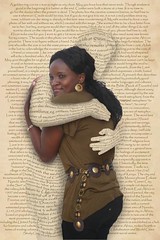
 Image by Robbert van der Steeg via Flickr
So one of my students says to me the other day...
"Ms. H, don't you think we over analyze this stuff. I mean really, do you really think all of these authors sit around and THINK about this stuff? Do they really spend hours coming up with metaphors and symbolism and word choice? They just say stuff don't they? Doesn't it just flow out of their heads? Come one, do we really need to talk about WHY and author does something and why it is important?"
I responded with yes, yes they do and yes, yes we do.
Well author lady :) do you have a response for my lovely student?
Dear LS (Lovely Student),
I remember thinking exactly the same thing, frustrated by what I thought was over analysis of a book. In class we weren't just looking for symbolism - it seemed like cannibalism, starting with decapitation! I would feel sorry for the author's who had no idea, I imagined, that we were torturing their babies.
I also thought for many years that I wasn't a writer, because "stuff" didn't flow out of my head whenever I wrote. Sometimes it did and it still does, of course. But that is grace. It took a long time for me to understand what the saying: labor of love meant, and I think that ALL writers and artists feel that way about their craft - it is work, but they love it, we love it.
Picasso would paint a picture over and over again, in different colors and shadings, just to rule out everything that wasn't right. It is the same with writers, published or not, who keep at it. I always wrote, but I wasn't real writer until I fell in-love with revision, until I trusted that I could be embraced by the right words.
I am at the beginning of my writing career, and I wish that I could show you drafts of my work. Edges went through 13 drafts. The first draft did come easily, I have to admit, but it took that long to really find the story. Now I'm no Picasso, but I kept thinking of him with each draft I did. The first one was too blue, the second one too red (and so on.)
I am working on a third draft of a manuscript now, changing the narrative from the third person to the first person. I couldn't hear my character's voice before, and now I can. It changes everything.
Am I answering your questions? Because I also want to address why you are asking them at all. (And I'm glad that you're asking, even if it's out of annoyance.) I suspect that you are right on the cusp of discovering yourself through critical thinking. I suspect that you are frustrated because you don't realize how important developing your own perspective is. You matter. You are learning to discern what works for you and what doesn't in not only books, but in your life. That's worth exploring, isn't it?
Fiction works on so many different levels. 100 people are going to have 100 different reactions to the same book! We can't help but see the world through our own limited experience. The hope is that literature will raise our consciousness, but of course not every book does that for every person.
(I don't like a lot of books that everybody else loves and vice versa!)
I worked hard on my papers in high school because books and words fascinated me, but I also needed good teachers to show me the way, to tell me what to look for.
But never what to think.
From reading, discussing and writing, I learned not only about story structure, but who I was, what I believed in, what I thought. If I disagreed with something, I learned to say so, and to present a pretty good argument. I saw the power of words and respected them. Words are a powerful tool, and they can be your tool too!
LS, "writers" aren't the only ones with a monopoly on words. You will be able to find your own, I promise.


