Léna is also a Regional Manager for Writopia Lab whose mission is to foster joy, literacy, and critical thinking in kids and teens from all backgrounds through creative writing.

"Well, the question is, what do you want to believe? Do you want to live in a world where things are possible, or in one where they aren't?" Cin, Edges.

Showing posts with label writing. teaching. Show all posts

Monday, February 7, 2011

Dear Student

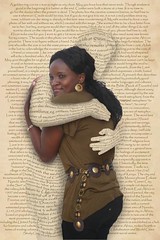
Embraced by WordsImage by Robbert van der Steeg via Flickr
One of my cyber friends, Jodi H, a fabulous teacher in the state of Washington has prompted today's post. She writes:

So one of my students says to me the other day...

"Ms. H, don't you think we over analyze this stuff. I mean really, do you really think all of these authors sit around and THINK about this stuff? Do they really spend hours coming up with metaphors and symbolism and word choice? They just say stuff don't they? Doesn't it just flow out of their heads? Come one, do we really need to talk about WHY and author does something and why it is important?"

I responded with yes, yes they do and yes, yes we do.

Well author lady :) do you have a response for my lovely student?


Dear LS (Lovely Student),
 
I remember thinking exactly the same thing, frustrated by what I thought was over analysis of a book. In class we weren't just looking for symbolism - it seemed like cannibalism, starting with decapitation! I would feel sorry for the author's who had no idea, I imagined, that we were torturing their babies.

I also thought for many years that I wasn't a writer, because "stuff" didn't flow out of my head whenever I wrote. Sometimes it did and it still does, of course. But that is grace. It took a long time for me to understand what the saying: labor of love meant, and I think that ALL writers and artists feel that way about their craft - it is work, but they love it, we love it.

Picasso would paint a picture over and over again, in different colors and shadings, just to rule out everything that wasn't right. It is the same with writers, published or not, who keep at it. I always wrote, but I wasn't  real writer until I fell in-love with revision, until I trusted that I could be embraced by the right words.

I am at the beginning of my writing career, and I wish that I could show you drafts of my work. Edges went through 13 drafts. The first draft did come easily, I have to admit, but it took that long to really find the story. Now I'm no Picasso, but I kept thinking of him with each draft I did. The first one was too blue, the second one too red (and so on.)

I am working on a third draft of a manuscript now, changing the narrative from the third person to the first person. I couldn't hear my character's voice before, and now I can.  It changes everything.

Am I answering your questions? Because I also want to address why you are asking them at all. (And I'm glad that you're asking, even if it's out of annoyance.) I suspect that you are right on the cusp of discovering yourself through critical thinking. I suspect that you are frustrated because you don't realize how important developing your own perspective is. You matter.  You are learning  to discern what works for you and what doesn't in not only books, but in your life. That's worth exploring, isn't it?

Fiction works on so many different levels. 100 people are going to have 100 different reactions to the same book! We can't help but see the world through our own limited experience. The hope is that literature will raise our consciousness, but of course not every book does that for every person.
(I don't like a lot of books that everybody else loves and vice versa!)

I worked hard on my papers in high school because books and words  fascinated me, but I also needed good teachers to show me the way, to tell me what to look for.

But never what to think.

From reading, discussing and writing, I learned not only about story structure, but who I was, what I believed in, what I thought. If I disagreed with something, I learned to say so, and to present a pretty good argument. I saw the power of words and respected them. Words are a powerful tool, and they can be your tool too!

LS, "writers" aren't the only ones with a monopoly on words. You will be able to find your own, I promise.


Enhanced by Zemanta

Tuesday, February 1, 2011

Race To Nowhere

Day 25: Race To NowhereImage by Visions By Vicky via Flickr
High Schools all over Westchester are hosting viewings and discussions of Race to Nowhere, a film that documents the growing stress upon students in the United States.

Many of my friends, old and new, gathered last night in the auditorium of John Jay High School in Cross River to watch this film together. We knew what it was about, and thought it would be much like preaching to the choir. None of us want to see our kids saddled with five hours of homework a night, to see them resort to losing sleep, taking drugs to stay awake, and ultimately cheating, just to get an A that will propel them through the college application mill.

I had so many feelings watching this movie. Anger and sadness for kids who are under so much pressure; happiness that I myself am doing what I love; worry about the unintentional pressure I put on my own kids; and even sadness for my own childhood, where I was under such pressure to "perform" as well.

Wanting to have a personal antidote to this school madness, I felt pleasure and gratitude at being a part of Writopia, where there's value in individual expression, finding the story, and solving the very problems you've created. And indeed, a couple of my own students' parents have called me after they've seen Race to Nowhere, telling me they were glad their child is enrolled in Writopia, that their child is falling in-love with writing, with learning. That's what every teacher wants to hear.

Then again, I'm faced with the fact that Writopia looks fantastic on a resume, and that to motivate our young writers and build their confidence, we encourage them to enlist in the prestigious Scholastic Art and Writing Awards. They might not win, but I believe that chances are they will, and THAT looks good on a college application. I also take pride in the 100% success rate I've had working with the students on their college essays. So does my warm and fuzzy teaching style, the "let's have FUN!" attitude, still end up as a gear in the mill?

While I can take solace in Writopia's non-profit mission and that my students can value achievements that serve their personal expression instead of the No Child Left Behind legislation, I feel badly for all the wonderful public school teachers out there, forced to shelve the values that prompted their careers, and to "teach to the test" in order to stay working. I feel badly for parents who only want their kids to have every opportunity, and badly for the kids who have a higher risk for depression and anxiety.

It has been discovered that homework does not have a direct correlation to achievement in elementary school, and only a modest correlation in middle and high schools. How many adults take home five hours of work with them after they leave work? And most students feel that homework is stupid busy work - who knows better than them that it's not helping them learn? Can you imagine how much of a toll that takes on their overall health? A statistic was cited last night: ten years ago one out of ten college freshman were taking psychotropic medication, and today that number has risen to one in four. A monstrous public health problem.

We live in a society where success is measured by how much money you make. I myself struggle with that paradigm. Now the income gap is widening, and kids think that they're losers if they don't fit the mold that maybe only 1% of people do. Why do we have a system in which every student is mercilessly geared toward a Harvard application? Not every student needs or wants a Harvard law degree or MBA, and shouldn't our future teachers, auto mechanics, carpenters, and writers be able to pursue what they love and have that process be valued? 

Even though I didn't require any convincing, Race to Nowhere was a real slap in the face, seeing what we as a Nation are doing to our future, turning our kids into mini stressed out versions of ourselves and robbing them of their childhood. The college application mill we've imposed upon our kids (virtually from birth now) doesn't allow much room for creativity, experimentation or failure.

The most valuable thing my grandmother ever told me was that if you are not free to fail, then you are not really free.

We need permission to fail, to learn from our mistakes, to grow, to be human. This race to nowhere is not helping our children grow up prepared for the beautiful and sometimes bitter twists and turns of life. More than ever, we live in a culture of entitlement and disappointment as our dreams for ourselves fit one narrow paradigm of achievement. We must come to enlarge that paradigm: to value curiosity and abstract thinking, to value all members of our community, no matter what gender, race, sexuality, learning style/ability, artistic temperament, or where they fit on the economic spectrum.

We need to focus on the process of becoming human, rather than being a "product" with X amount of money and material things. We need to understand that failure is part of that process, and that learning to pick ourselves up and dust ourselves off is an important skill. Now who is preaching to the choir? ;-)

Enhanced by Zemanta

Monday, July 5, 2010

The Thlot Pickens . . ..


"If you're rewriting a story, is it okay to to use the same plot, or do you find yourself stuck in the same problems?" One of the teens in yesterday's workshop asked me. I had never heard the question about REVISION phrased in this particular way. Have an outline, fill in differently. See how refreshing Writopia is?

We launched into a discussion about structure vs. plot.

(I had hammered out the plot to EDGES in three months, but it took me three years of rewrites and playing with the structure before getting it into the hands of a publisher.)

"How do I do that? How do I know whether or not the structure is working?" She asked.

"That's what we're all here for!" Learning how to both get and give constructive feedback are two of the main goals of workshopping.

This group is split between teens whose writing tends to be plot driven and those who prefer character driven stories. Since both character and plot inform each other so much, these guys and gals have much to learn from each other this week. I relish being their guide and witness.

I suggested switching her Point of View, see the "plot" from another character's eyes, or to simply change the narrative from third person to first person.

Picasso was known to use canvasses over and over again, switching colors, form, content - he had to "rule out" certain factors first, before getting to the heart of his painting.

This is a helpful reminder for me as well: I have a manuscript about a reality TV show (based on my personal experience) that I'm getting excited to get back to, which I wrote as a double narrative in the third person. Maybe I should be open to switching it to a single narrative in the first person. This may alter the plot, structure and character arcs a great deal, and might work better. Or it might not, but I will learn more about my characters and their stories in the process!

Wednesday, June 16, 2010

Tighter Writing


I am sitting in a workshop at Writopia with four amazing fifteen year old girls. We have all kicked off our shoes, and are settled in to work on some serious fiction and memoir.

We are mid-way through our week of writing "camp". By Friday and after fifteen hours together, they will all have polished pieces. The girls are tapping furiously away on their laptops, after our first hour of workshopping - reading each others pieces and commenting on structure, narrative and character, always on the watch-out for compliance with the initial objective.

They are all writing, so I have a few minutes to write too, to BLOG, which is something that I don't have time to do with my younger groups, who need/want more hand holding through the process. (And I love them too!)

These girls are all inspiring, aspiring authors - one is writing a beautiful memoir piece off of a prompt that I gave her when we began - all about image and cultural dissonance. Another is writing an elaborate fantasy that will one day turn into a trilogy no doubt, but for now, her task is to focus on a complete stand-alone piece. The other two are working on two very different realistic fiction stories.

Teaching helps me to become a better writer - a tighter writer, to focus on all of the things that I ask them to develop an awareness of. Objectives, rising action, "crisis" and resolution: keeping it simple. My habit is to throw everything I care about, all sorts of psychological complexities into whatever novel I'm working on. Too many issues! The good thing is that I have a lot to write about, and no shortage of ideas for novels. EDGES at first could have been two or three novels. I had to cut out so much, and it is a much better book because of that.

And now I must get back to my beauties, tearing them away soon from their own work so that they can get and give feedback, all the while learning themselves how to be a tighter writer.

And tomorrow after workshop . . . I finally get to meet my publicist/marketing person for EDGES at a cafe in the FlatIron District! Yay! More later . . .

Saturday, April 17, 2010

Willingness to . . .


I'm thinking of the importance of willingness today. The willingness to change and take risks, the willingness to stay open, the willingness to be conscious and awake, the willingness as writers to follow the story. And the willingness to be an active participant in my own story.

At Writopia, the kids in my workshops teach me about willingness through their creative process. They are willing to jump in and aren't paralyzed by fear of perfection. They are willing and able, allowing themselves, with my support, to enter the realm of creative chaos, and then my job is to help them train it with grammar and narrative integrity. (Notice that I write "train" instead of "tame" - we don't want tame writing! See blog post How To Train . . .) It's amazing what a little grammar can do!

So this translates to life, yes? Willingness to change: A friend of mine said today that change is easier in some ways for him when he has no choice. We turn it over and do our best to move on with our lives. But instigating change ourselves to better our own lives, being the architect, taking responsibility for our choices, now that's a toughie! I found myself nodding in agreement with him: you are not alone, brother.

I don't know about you, but, but my characters take on a life of their own. I get to shape them, but they tell me who they are. Like children, like myself, becoming conscious of my choices and my dreams.

So this is a long way of telling you all, that for the past year, my family and I have been gearing up for a huge change: leaving NYC for Northern Westchester County. Suburbs! This is the first time that I've even said that word! I've just been thinking of it as: out of the city, where there's more space, the schools are good, and real estate is (a little) cheaper.

My dream is to write, and to make a living as a writer, but living in NYC has been a stressful living beyond my means. Sure, I have pieced together a living, and I am GETTING PUBLISHED! Freaking fantastic! Somewhere inside of me, I had the willingness to write and to persevere. But in order to continue, I need to lower our cost of living by leaving the city. I mean, what are the odds of Miramax buying the rights to EDGES? So I have to be willing to do what it takes to keep writing.

What are we willing to do to live (forgive me for chaneling Oprah!) our best lives?