I had no idea that Adam was a writer, until he friended me on Facebook and I started getting announcements and reviews about his book: The Thieves of Manhattan: A comic literary thriller in which a down-on-his-luck writer finds himself ensnared in a web of deceit when he puts his name to a fake memoir.
It's his fifth book, mind you, so I don't know what planet I've been on. Planet Mommy, Planet Writer. Adam was another parent of a delightful girl at my daughter's pre-school. We had talked parenting, sleep deprivation, potty-training. Talk about ourselves? Never!
So I finally got off my duff and started reading his book the day before yesterday, finished last night. Fake memoir? Might this also be a social commentary on the publishing aka entertainment industry? The hours I spent reading Adam's book were all too short. I laughed, chuckled and snorted at Langer's humorous semiotics and publishing caricatures, creating a literary world where glasses are called "franzens" (nod to Jonathon Franzen) and cocktails are called "fitgeralds" and "faulkners". A comic literary thriller indeed! These adjectives may seem oxymoronic, but with Langer, he makes the case for a new genre with grace and finesse. All the while Langer's prose tease and stimulate as he weaves his own questions about story as truth.
Fake memoirs, small stories about genuine emotions, pumped-up reality, outrageous fantasy: "The only way you could sell this story is if it was true," an agent tells one of Langer's characters. Well, what if it was? The lines between fact and fiction are blurred in this society where we are encouraged to constantly reinvent ourselves.
And so obviously, I couldn't help thinking about my grandmother as I read in between the lines. STORY AS TRUTH is what Madeleine L'Engle frequently wrote and lectured about, that stories are how we learn about our humanity. She had been ahead of her time, moving between fiction and memoir in the 1970's. But was everything "true"? She always wrote and lectured about "story as truth". How can someone remember everything she/he said and did? There has to be some conceit in holding the story together, even if it the story of our lives. We have to leave some things out maybe, in order to move the story along. "I know it's true because I wrote it in my journal," she would say. Well. That's another issue. We all know how we have our own perspectives and our own personal truth. So maybe the only universal truths are in "story", and that's why we read them. To watch a character's growth or downfall. But I digress.
Adam was kind enough to answer some of my questions late last night and I will share them you here:
Me: What is your process for writing? Do you have the idea first, and then outline? Or do the characters take over and tell you what they want to do?
Adam: Usually it starts with a very small idea and I build on it by continually asking myself questions about characters and building out from there. My first novel Crossing California began with imagining three characters on a street corner--and once I had begun answering all the questions I had (who were they, where were they, when were they doing whatever they were doing, and so on), I had the beginning of a novel. The same thing happened with Thieves more or less--I started with a guy working in a cafe in Morningside Heights, looking at the book a stranger was reading. The more I thought about that small image, the more questions I had, and the more answers I had to come up with.
Adam: I don't know if the characters "tell" me what they want to do, but part of the liberating quality of writing is allowing yourself to be surprised. I never outline, largely because if I already know the answers to the questions I have, the writing process becomes less an artistic and inspired one than a matter of filling in the blanks.
Me: Which do you prefer, creating the first draft, or the revision process?
Adam: I like them both for different reasons. I love the experience of filling a blank page, of being totally surprised by what winds up on that page, of allowing a story to go any way it can. At the same time, that process can be a bit frightening. Once I have a beginning, middle, and an end, the process of revising is, in some way, more freeing because I know I have a framework upon which I can improvise and that even if I screw it up, I'll always have the basic story to fall back on.
Me: How do you balance practicing your craft with the practice of being a parent?
Adam: Well, I'm sure you know this better than me, it's a major challenge, particularly since we don't usually use babysitters, plus we have kids who don't really like to sleep before, say, 10 PM. I used to have a minimum of eight-to-ten hours of creative time per day; now, I'm lucky if I have half that. Basically, it means I have to try to be very efficient and very targeted, otherwise it's all too easy to let a day's writing succumb to cooking dinner, walking the dog, doing the laundry, buying shoes, and so on, and so on, and so on. I usually set myself the goal of 1,000 words per day--Graham Greene once set he wrote 500 words per day and that always sounded somewhat puny to me, so I decided to double it--now that I've been a parent for five or so years, I have to get those thousand words out in far less time than I was used to.
Thank you, Adam! And thanks to the three of you who read this incredibly long post. Now go and buy his book. I would lend it to you, but Husband has first dibs!
Friday, August 13, 2010

Wednesday, August 11, 2010
Writers Need Dance Breaks
 Image via Wikipedia
It's impossible for me to write for three straight hours (unless I'm wading in a revision), so we certainly can't expect the same of them at Writopia. Writing is FUN!
These girls have bonded in the past few days, have exchanged emails and even planned a sleep-over, finding creative expression not only in their writing, but in how they interact with each other.
They are so "fresh", in all senses of the word: new, impudent, cool. They don't yet have the self-consciousness that will unfortunately come all too soon. They're not afraid to dance: to embrace the drama in their imaginations and then to exorcise it with movement and music.
Us "grown-ups" need to take a page from their book. Life is too serious to be taken seriously.

Tuesday, August 10, 2010
The Kids Books Are MORE THAN All right
I was alerted to this NY Times article yesterday by friend/author Deborah Heiligman. I read said article, delighted at first, but then began to think more critically as I followed Deborah's fantastic discussion on Facebook. Today, Deborah linked to her friend Gayle Forman's awesome blogging about her own response to this article. Deborah and Gayle both responded in the way my grandmother would, that the article damns with faint praise.
"I write for people," I can hear my Gran's exasperated voice. "Aren't children and teenagers people?"
I applaud though, anything that highlights YA as bona fide literature. Where else can you find really tight writing, where every word counts? Saying that we shouldn't be embarrassed to read YA implies that everybody thinks of it unsophisticated brain candy, fluff.
I'll end this short post with a quote from Kurt Vonnegut that I found on Zelda del West's blog:
Well, I've worried some about, you know, why write books ... why are we teaching people to write books when presidents and senators do not read them, and generals do not read them. And it's been the university experience that taught me that there is a very good reason, that you catch people before they become generals and presidents and so forth and you poison their minds with ... humanity, and however you want to poison their minds, it's presumably to encourage them to make a better world.
Doesn't that say it all?
Sunday, August 8, 2010
Writing Hints and Journaling Helps
 Image via Wikipedia
But I do. Of course I do! I'm a teacher, so I don't know where this modesty is coming from.
I am a writer. I write, even when I think I can't. When I think I have nothing to say. Especially then. My Gran always told me that journals are never to be read by other people, so we can feel safe to practice writing. Daily. (Although she has let me read some of her very early journals, and they read very well!*)
I've kept a journal since I was nine - at first, short stories and detailed observations, then my more complex emotional landscape, discovering what I was feeling and working those feelings out. Getting out all the ugliness. Journals are boring to read: I'm mad at my mom, dad, sister, I feel fat, I feel jealous, I feel miserable . . .then chronicling my daily activities, adventures (yet still boring).
In my mid-20's I read The Artist's Way by Julia Cameron, and for years I did those morning pages, "emptying out the garbage" as she calls it. After having my first child, I found it impossible to write first thing in the morning, but I discovered that I could turn them into evening pages. Today I do some kind of writing every day, be it journaling, working on my fiction, and now blogging! (In fact, I read somewhere that blogging is the number 1 way to become a better writer.)
As for "hints" and "helps" dear Anonymous, PROMPTS are delicious. For fiction: Get them online, or think of a person, place or thing, and an action. A personal favorite of mine is "The glass shattered . . ." Can you see the infinite possibilities from those three words? Or look at a painting that you love and discover a story in the picture. I love Salvador Dali's Persistence of Memory . . .or a photography book. (Use the photograph above if you like.) Or take 3 inanimate objects in your bag, your house, your car, and discover their relationship. What would they say if they could talk?
For journaling: I am a woman (man) who . . . It makes me angry when . . . I love . . .or write everything about an object that has meaning to you. Use all of your senses.
The world is rich and layered - there are prompts all around us.
But most of all, give yourself permission to write. Give yourself the personal and physical space. Don't be afraid to sound boring!
I will leave you with a prompt for today: She was about to fall off the chair . . .
*Gran stipulated in her will that her journals couldn't be accessible to the public until fifty years after her death.

Thursday, August 5, 2010
Rejection is . . . God's Protection . . .
 Image by [blu:]skin via Flickr
She took six months before calling me and saying "I don't think that this is a good follow-up book for you." Fortunately, at the time, I was knee deep in my WIP (the companion book to EDGES and the one I'm waiting for my agent's editorial letter. Edward, if you are reading this, hint, hint!) and didn't start beating up on the "rejected" one right away.
My editor called to tell me this as I was on my way to the monthly Writers 4 Writers lunch, proving to be the perfect venue for shedding a tear, for these women had all been through it. "What? Send it to another editor!" They all cried. But thoughts immediately went to my grandmother, whose Wrinkle in Time, legend has it, was rejected 17 times! Did she send out the same manuscript over and over again? No, she reworked it each time, and that's what I would do.
But first I had to finish my WIP, hand it into my agent, and move to the suburbs, you know, little things.
So here I am blogging and procrastinating from reading the old manuscript, GRATEFUL that it was rejected. The characters need deepening, it needs restructuring. It's plot driven! Oh the scandal!
Rejection is God's protection - a dorky creed I say to myself to remind me not to take things (too) personally. It also implies that there is a reason for everything, which I believe most of the time, but sometimes a cigar is just a cigar, you know? Sometimes amazing work is rejected and there's no reason for it. But this manuscript is not amazing, and I know that I can do better, and that I need to keep slogging - I mean writing and working on it as I do on myself.
I don't think that I'm alone in being a writer who has highs and lows regarding their work. I'll have a writing session one day and feel on top of the world about it, and then come back the next day and scratch my head. This was good? So I'm probably just being especially hard and unforgiving of my manuscript, the baby I worked on for a year of my life . . . but what's another year?
And in the meantime I can look forward to the release of EDGES and be proud that I am putting the best work that I can out there. My gratitude list is immense!

Wednesday, August 4, 2010
Author's Statement, take 2
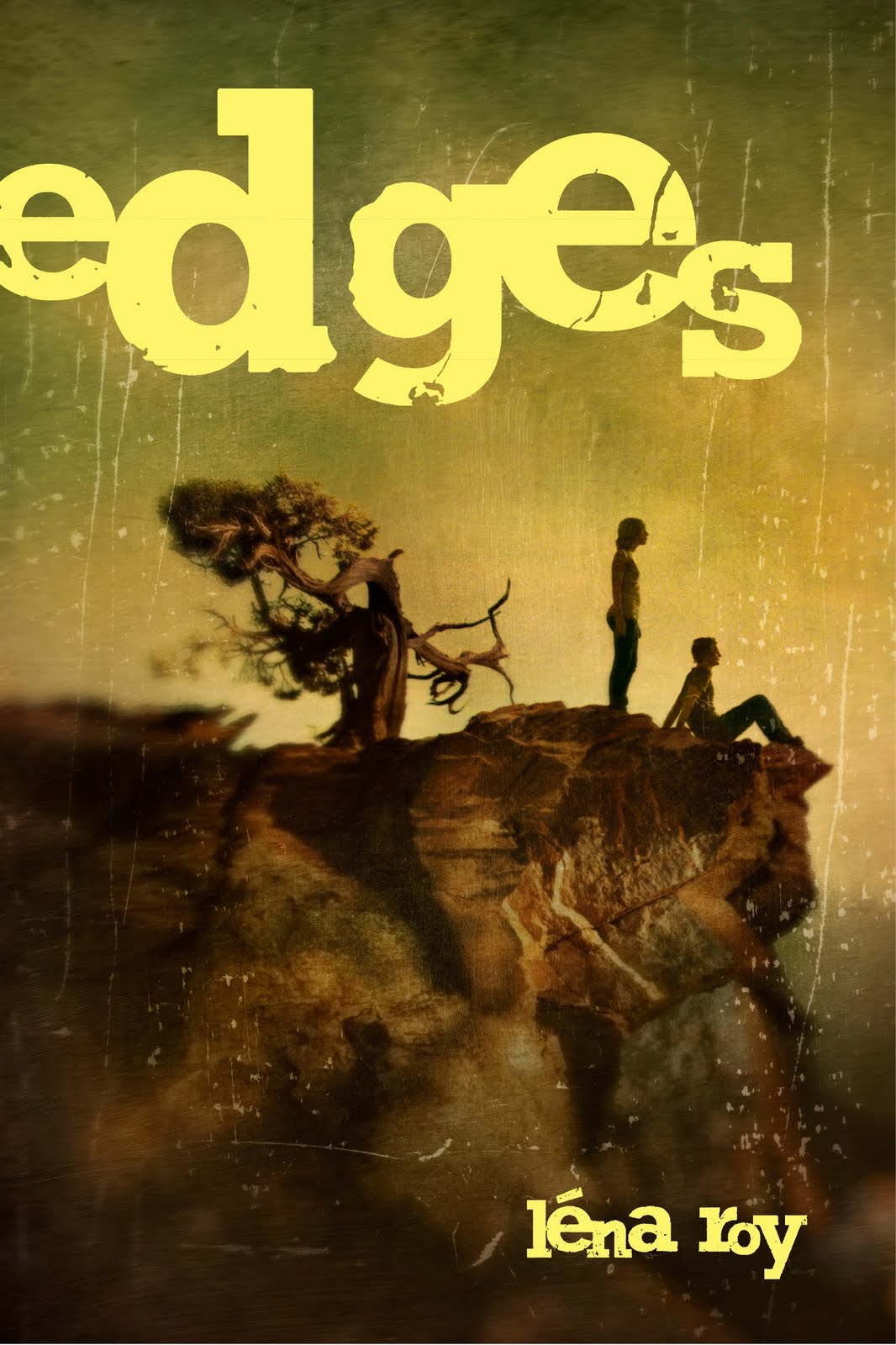
EDGES was borne out of the year I spent in Moab, Utah. I had never heard of Moab before I went out west from New York City on vacation with a friend. We stayed at the Lazy Lizard Youth hostel where I met a cast of characters, including the man who would ultimately become my husband.
The surreal landscape of barren earth and red rocks called me to change my life, lobbied me to quickly, almost impulsively, quit my job as a Drama Therapist on the psychiatric floor of a hospital in the Bronx. It was meant to be: Moab’s Four Corners Community Mental Health Center needed someone to help start up an intensive out-patient program for teens.
My adventure to the desert shocked my family, friends, and most of all myself. Counseling teens in rural Utah? I was pushing the boundaries of my self-perception. To get on my feet, I stayed at the youth hostel where I had made some friends. Among the personalities at the hostel was a charismatic teen who had pitched a tent in the back and was ostensibly "living" there. Nobody knew his real story, and then one day after a long hike, I heard that this boy had moved on.
I’ve wondered about him ever since.
My work that year consumed me. I was naively shocked when a 14 year-old girl was sent to me for her habit of shooting crystal meth. She wound up in the hospital and an in-patient program. Most of the teens I worked with were court-ordered; it was all intervention and no prevention. I introduced them to a variety of tools, including behavioral therapy, the twelve steps of Alcoholics Anonymous and some outward-bound type hiking sessions. My faith in love and the universe was sorely tested treating these young men and women who were only seeking a way to transcend a hum-drum existence: drugs and alcohol replacing faith.
I was constantly asking myself questions. Aren’t we all seekers of some sort? Isn’t that what I was doing in Moab? Why is addiction so pervasive, and allowed to go unchecked? What road map can we offer kids who are lost, to help them find their way? Books have always been a kind of map for me, but I couldn’t find any fiction about the process of recovery. We all need some kind of guide, but our society trains us to use people, places and things in an addictive way, leaving us no room for faith in ourselves, let alone a Higher Power.
Years later, back in New York City, I had gone on to work as a high school counselor, was beginning to raise my own children and was helping take care of my aging grandmother, author Madeleine L’Engle. It was she who’d given me my first journal when I was a child, and though I always wrote, I’d never dared follow in her literary footsteps. She’d won the Newbery for A Wrinkle in Time and written over sixty books! My grandmother had always encouraged me spiritually and creatively, yet as her health declined she felt lost to me. It was only after she died that I felt her spirit again and found the persistence to finish a novel.
One morning seven years ago, the boy from the youth hostel figuratively tapped me on the shoulder and whispered the first scene of EDGES. I wrote furiously as if taking dictation. I called my protagonist Luke, and he was running away from his mother’s death and father’s alcoholism in New York City to a youth hostel in Moab, Utah.
I wrote the first draft in about three months, and then kept revising. At first I was obsessed with the crystal meth problem. I read great books with graphic depictions of the descent into addiction, but nothing about the journey beyond that addiction. I was more interested in asking: what happens when you take away the substance? Or, if like Luke, you just run away? What does it take to remain authentic, to maintain a sense of who we are when our perceptions of the world are challenged?
I write to map the world, and EDGES came from my desire to portray transcendence amidst bleakness, my interest in flirting with the edges of mysticism and insanity, my curiosity in challenging where our personal edges are.

Monday, August 2, 2010
Why I Wrote EDGES, take 1

EDGES was borne out of spending a year in Moab, Utah. I had never heard of Moab before I went out west from New York City on vacation with a friend, staying at the Lazy Lizard Youth hostel where I met a cast of characters, including the man who would ultimately become my husband.
The landscape called me to change my life, pushing me to lobby hard to find a job so that I could move from the Upper West Side of New York City to this surreal place of barren earth and red rocks. It was meant to be: Four Corners Community Mental Health Center needed someone to help start up an intensive out-patient program for teens.
To get on my feet, I stayed at the youth hostel where I had made some friends. Besides my future husband, there was a charismatic 16- year-old boy who had pitched a tent in the back and was ostensibly "living" there. Nobody knew his real story, and one day after a long hike, I found out that the boy had left. I’ve wondered about him ever since.
My work that year with the teens was all-consuming. I remember being naively shocked when I had a 14 year-old charge come into see me for shooting crystal meth. She wound up in the hospital and an in-patient program. Most of the teens I worked with were court-ordered; it was all intervention and no prevention. My faith in love and the universe was sorely tested treating these young men and women who were only seeking a way to transcend a hum-drum existence: drugs and alcohol replacing a Higher Power.
I was constantly asking myself questions. Aren’t we all seekers of some sort? Isn’t that what I was doing in Moab? Why is addiction so pervasive, and allowed to go unchecked? What road map can we offer kids who are lost, to help them find their way? Books have always been a kind of map for me, but I couldn’t find any fiction about the process of recovery. We all need some kind of guide, but our society trains us to use people, places and things in an addictive way, leaving us no room for faith in ourselves, let alone a Higher Power.
Years later, back in New York City, after more work with teens and taking care of the first two of my three children, the boy from the youth hostel figuratively tapped me on the shoulder and whispered the first scene of EDGES. I wrote furiously as if taking dictation. I called my protagonist Luke, and he was running away from his mother’s death and father’s alcoholism in New York City to a youth hostel in Moab, Utah.
The first draft spilled out in three months, but then I had to work on my craft and keep revising until I got it right. At first I was obsessed with the crystal meth problem. I found a lot of books with graphic depictions of addiction, but nothing about the journey beyond drug/alcohol induced behavior. It became more interesting to ask questions: what happens when you take away the substance? Or, if like Luke, you just run away? What does it take to be authentic, maintaining a sense of who we are when our perceptions of the world are constantly challenged?
We write to understand the world, at least I do, and EDGES came out of a need to find hope in a sometimes bleak world, hope in a time where it's so easy to go over the edge, and somehow more difficult to find your own personal edge - stretching yourself and your mind beyond what you thought possible.
I am glad that EDGES will find it’s way to a teen and adult audience. It is my hope that it will make people think about their relationships to addiction and transcendence, that it will serve as one of many road maps along the way to adulthood, and comfort to ones who are already there.

Subscribe to:
Posts (Atom)